The Death of Third-Party Cookies: What Marketers Must Do in 2026
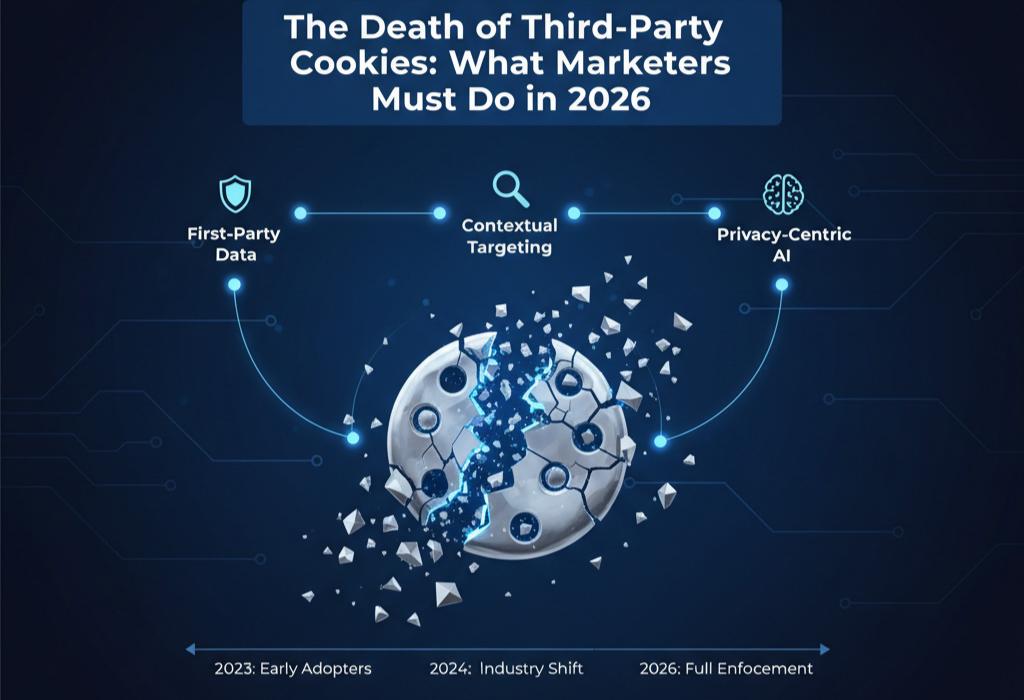
The Death of Third-Party Cookies: What Marketers Must Do in 2026
A new era characterized by data ownership, openness, and privacy is emerging in the digital marketing ecosystem. As popular browsers like Google Chrome phase out third-party cookies, marketers need to completely reconsider how they get information, track results, and interact with consumers.
This change is strategic rather than just technical. Early adopters will have a competitive edge, whereas late adopters run the danger of losing customers’ trust and visibility.
Understanding the Shift Away from Third-Party Cookies
For many years, behavioral profiling, cross-site tracking, and accurate ad targeting were made possible by third-party cookies. However, their decline has been exacerbated by growing consumer awareness and governmental pressure.
Technology companies are being forced to give user consent and privacy a priority by frameworks like the CCPA and GDPR, which have established new norms for data protection.
Third-party cookie support has already been removed by browsers like Firefox and Safari, indicating a larger industry shift toward privacy-first technology.
Strategic Implications for Marketers
There are various structural changes brought about by the deprecation of third-party cookies:
- Limited cross-platform user tracking
- Reduced granularity in audience targeting
- Fragmented attribution models
- Increased reliance on owned and consent-based data
Forward-thinking marketers can see them as a chance to develop more ethical and sustainable data strategies rather than as limitations.
Prioritize First-Party Data Strategy
Nowadays, the foundation of contemporary marketing is first-party data.
Systems that collect, aggregate, and activate consumer data obtained through direct encounters should be purchased by businesses. This includes:
- Website engagement (with explicit consent)
- CRM and transactional data
- Email subscriptions and preferences
- Customer feedback and surveys
Personalization and compliance are made possible by an organized first-party data strategy, which eliminates the need for outside tracking systems.
Strengthen Customer Relationships and Trust
Trust becomes a crucial differentiator in an atmosphere that prioritizes privacy.
Brands must transition from passive data collection to active relationship-building by:
- Delivering consistent value across touchpoints
- Communicating transparently about data usage
- Creating meaningful engagement through channels such as LinkedIn and Instagram
When customers perceive value and transparency, they are significantly more willing to share their data.
Reinvest in Contextual Targeting
Contextual targeting is re-emerging as a viable and privacy-compliant alternative.
By aligning advertising with the content environment rather than individual user behavior, brands can maintain relevance without compromising privacy. This approach also enhances brand safety and contextual alignment.
Adopt Privacy-First Technology Solutions
Modern marketing requires infrastructure that balances insight with compliance.
Key solutions include:
- Server-side tracking frameworks
- Data clean rooms for secure data collaboration
- Privacy Sandbox initiatives led by Google
These technologies enable data-driven decision-making while adhering to evolving privacy standards.
Redefine Measurement and Attribution
Traditional attribution models are becoming obsolete in a cookieless environment.
Organizations should adopt more resilient methodologies such as:
- Media mix modeling (MMM)
- Incrementality testing
- Aggregated and probabilistic data analysis
The focus must shift from deterministic tracking to strategic interpretation of broader performance signals.
Elevate Content as a Core Growth Driver
In the absence of granular tracking, content becomes a primary lever for engagement and acquisition.
High-quality, intent-driven content:
- Builds brand authority
- Drives organic traffic
- Encourages direct user interaction
Content strategy should be integrated with SEO, brand positioning, and customer journey mapping to maximize impact.
Conclusion: From Tracking to Trust
The decline of third-party cookies marks a fundamental shift in digital marketing—from surveillance-based tactics to trust-based engagement.
Organizations that embrace this transition will not only ensure compliance but also build stronger, more durable customer relationships.
The future belongs to brands that prioritize transparency, invest in first-party data, and deliver genuine value.
Is your organization prepared for a cookieless future?
Now is the time to assess your data strategy, modernize your marketing infrastructure, and align with privacy-first principles.
Partner with us to build a future-ready marketing ecosystem.
From first-party data architecture to advanced attribution models, we help businesses navigate complexity with clarity.
Is your organization prepared for a cookieless future?
Now is the time to assess your data strategy, modernize your marketing infrastructure, and align with privacy-first principles.
Partner with us to build a future-ready marketing ecosystem.
From first-party data architecture to advanced attribution models, we help businesses navigate complexity with clarity.
Get in touch today to schedule a consultation and future-proof your marketing strategy for 2026 and beyond